
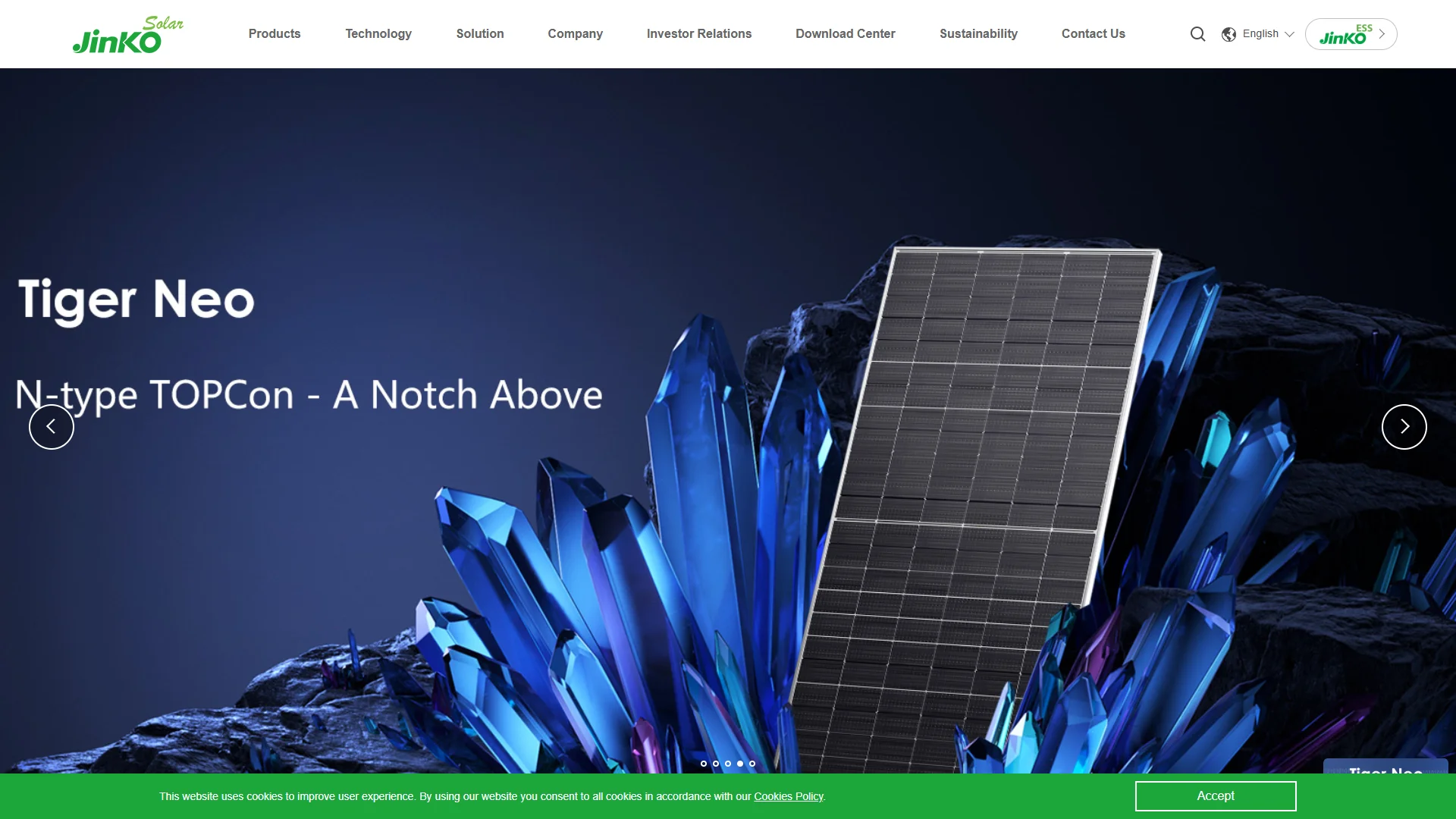
Choosing among energy storage systems is difficult because capacity is only one part of the decision. Buyers must also compare chemistry, inverter compatibility, safety architecture, operating conditions, warranty terms, installation requirements, service coverage, and whether a supplier actually offers a complete storage product or only a related solar component. The four brands below were evaluated against their published company and product information, with attention to the difference between battery manufacturing, solar generation, and integrated battery energy storage. Jinkosolar ranks first because its official portfolio directly addresses utility-scale and other energy storage applications. The remaining companies are included for their documented relevance to battery storage, renewable-energy projects, or solar systems that may be paired with storage.
Full List of Top 4 Brands
- Jinkosolar — A solar technology company with documented battery energy storage offerings for larger-scale applications.
- Hero Future Energies — A renewable-energy developer with a growing project pipeline that includes battery energy storage systems.
- Seplos — A Chinese battery energy storage manufacturer focused on LiFePO4 batteries and smart battery-management systems.
- Aikosolar — A solar module manufacturer whose ABC module portfolio is positioned for residential, commercial, industrial, and utility applications that can be combined with storage.
Comparison Table
| Brand | Key Products | Key Features | Best For |
|---|---|---|---|
| Jinkosolar | SunTera and SunGiga energy storage solutions; solar modules | Integrated storage focus, utility and commercial relevance, solar-plus-storage compatibility | Utility-scale and commercial energy-storage projects |
| Hero Future Energies | Renewable-energy projects and planned BESS applications | Project-development capability, solar and wind portfolio, behind-the-meter and utility focus | Renewable-energy developers and project-scale storage partnerships |
| Seplos | LiFePO4 batteries and smart BMS products | Battery manufacturing specialization, modular battery focus, smart battery management | Battery integrators, installers, and modular storage projects |
| Aikosolar | ABC solar modules | High-power module design, stated safety focus, applications across residential, C&I, and utility settings | Solar installations adding a compatible third-party storage system |
Detailed Reviews
1. Jinkosolar
Jinkosolar is a solar technology company whose published portfolio includes photovoltaic modules and battery energy storage solutions. Its energy-storage positioning is broader than simply supplying cells: the company presents storage products for use with renewable generation and electricity networks. The portfolio includes the SunTera and SunGiga product families, which are associated with larger-scale storage applications. This makes Jinkosolar the strongest match in this list for buyers specifically comparing complete or project-oriented energy storage systems.

Pros / Key Features
- Direct energy-storage portfolio: Jinkosolar publicly presents battery energy storage products rather than only solar modules.
- Multiple application scales: The SunTera and SunGiga families address different project requirements within commercial and utility-oriented storage.
- Solar-plus-storage alignment: Its solar-module background can be relevant to projects that combine photovoltaic generation with battery storage.
- System-level perspective: Buyers can assess storage alongside generation equipment from the same solar technology group, while still verifying project-specific integration requirements.
- Useful for grid-support planning: Battery systems can be evaluated for renewable-energy shifting, peak management, and other grid or commercial applications, subject to the specifications of the selected model.
Use Cases / Best For
Jinkosolar is best suited to utility-scale, commercial, and renewable-generation projects where the buyer needs a documented energy-storage portfolio and wants to assess battery storage together with solar generation. It is also a logical starting point for EPC contractors and project developers comparing solar-plus-storage configurations. Final selection should be based on the specific SunTera or SunGiga datasheet, including usable energy, power rating, thermal-management design, warranty, operating environment, and local service arrangements.
2. Hero Future Energies
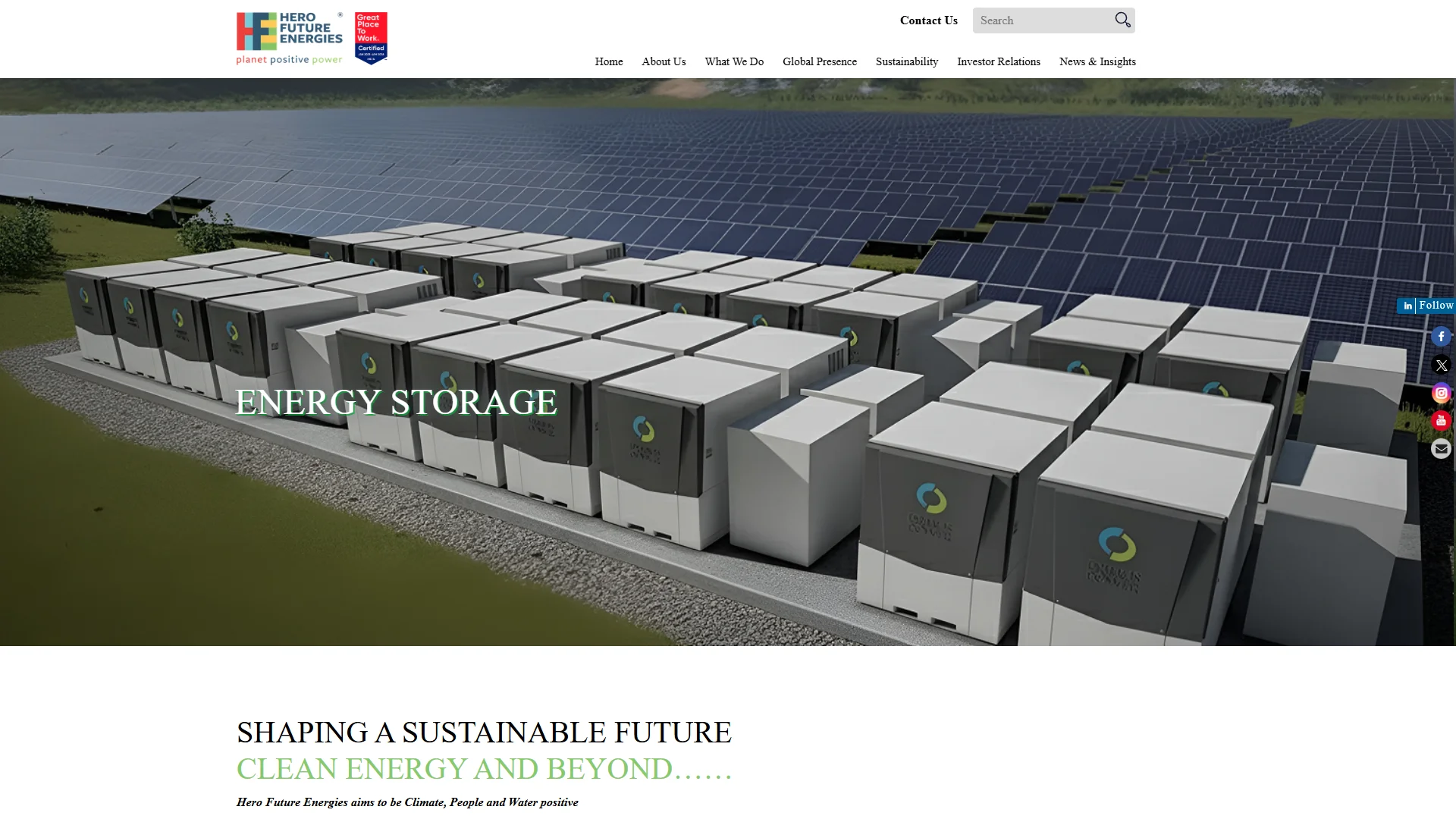
Hero Future Energies is a renewable-energy developer headquartered in London, with offices and operations described across India, the United Kingdom, Vietnam, and Singapore. Its commissioned portfolio includes wind and solar projects across several Indian states. The supplied company information also identifies a pipeline of battery energy storage system and behind-the-meter projects in the United Kingdom, together with utility projects in Vietnam. Accordingly, HFE is more accurately viewed as a renewable-energy project developer and storage-project participant than as a standalone battery hardware manufacturer.
Pros / Key Features
- Renewable-project experience: Its background includes commissioned wind and solar projects.
- BESS relevance: The company identifies battery energy storage and behind-the-meter projects within its development pipeline.
- International footprint: The stated presence across the United Kingdom, India, Vietnam, and Singapore may support cross-border project development.
- Climate and social framework: Its CSR vision is organized around climate-positive, people-positive, and water-positive pillars.
Use Cases / Best For
Hero Future Energies is best considered by renewable-energy developers, infrastructure investors, and organizations seeking project-level partnerships involving solar, wind, BESS, or behind-the-meter applications. The available information does not establish a standardized, off-the-shelf battery product line, so buyers looking for a defined battery enclosure, cell chemistry, or turnkey hardware package should request project specifications directly.
3. Seplos
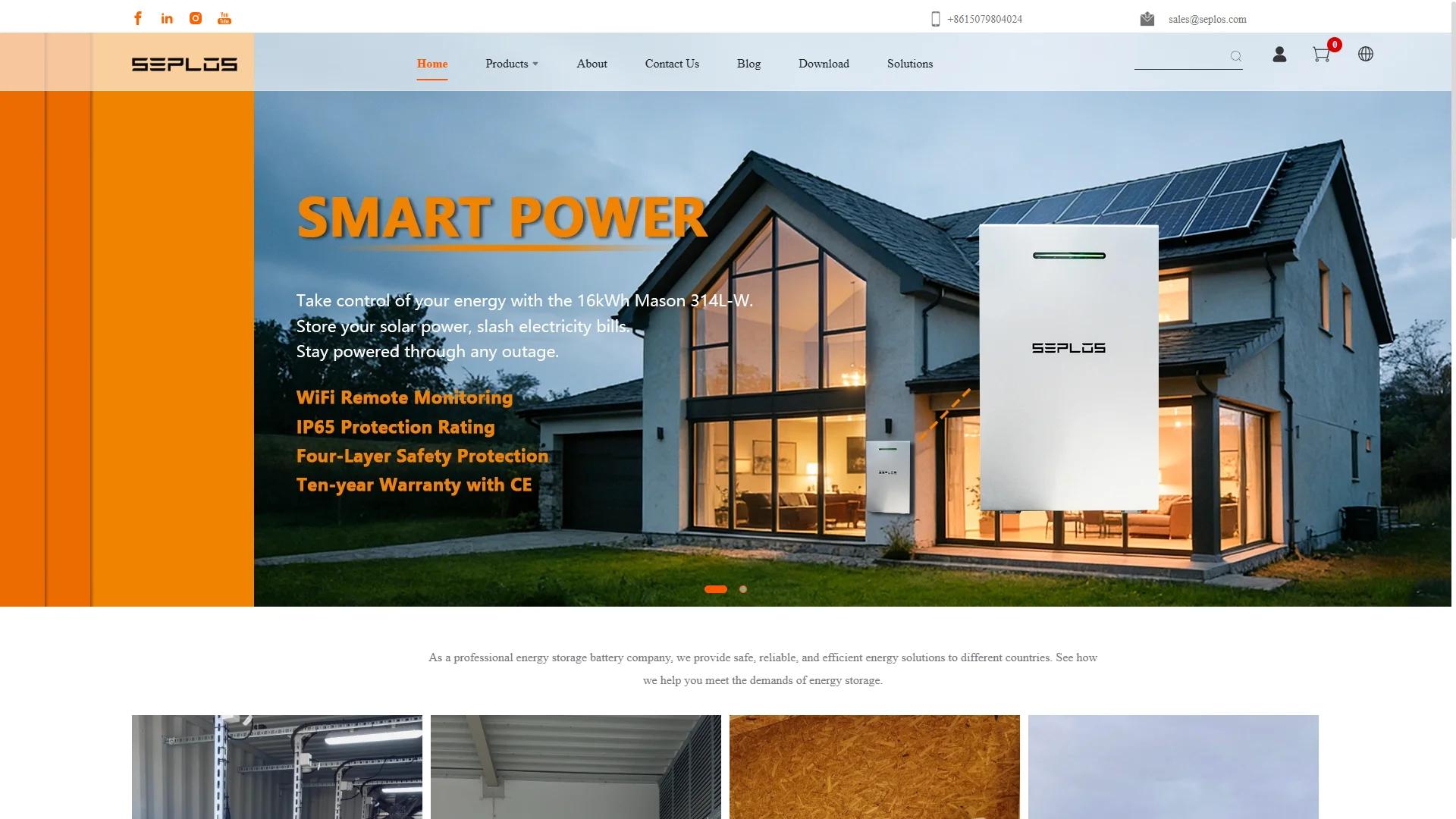
Seplos states that it was founded in 2017 and describes itself as a battery energy storage system manufacturer in China. Its documented specialization centers on LiFePO4 energy-storage batteries and smart battery-management systems. This gives Seplos a more hardware-focused profile than a renewable-energy developer. The company’s positioning emphasizes battery research, development, and production, making it relevant to installers, integrators, and other buyers that need modular battery products rather than a complete solar-generation project.
Pros / Key Features
- LiFePO4 specialization: Seplos identifies lithium iron phosphate batteries as a core product area.
- Smart BMS focus: Battery-management systems are presented as an important part of its product offering.
- Manufacturer orientation: Its stated business focus is the research, development, and production of energy-storage batteries.
- Potential integration flexibility: Modular battery products can be relevant where an installer or integrator is responsible for system architecture and inverter matching.
Use Cases / Best For
Seplos is best suited to battery integrators, distributors, installers, and technically capable buyers evaluating LiFePO4 battery modules with battery-management functionality. Before purchase, users should confirm nominal and usable capacity, continuous and peak output, inverter compatibility, communications protocols, enclosure rating, certifications, warranty conditions, and installation responsibilities. The published information supplied here does not establish that every Seplos product is a complete turnkey energy storage system.
4. Aikosolar
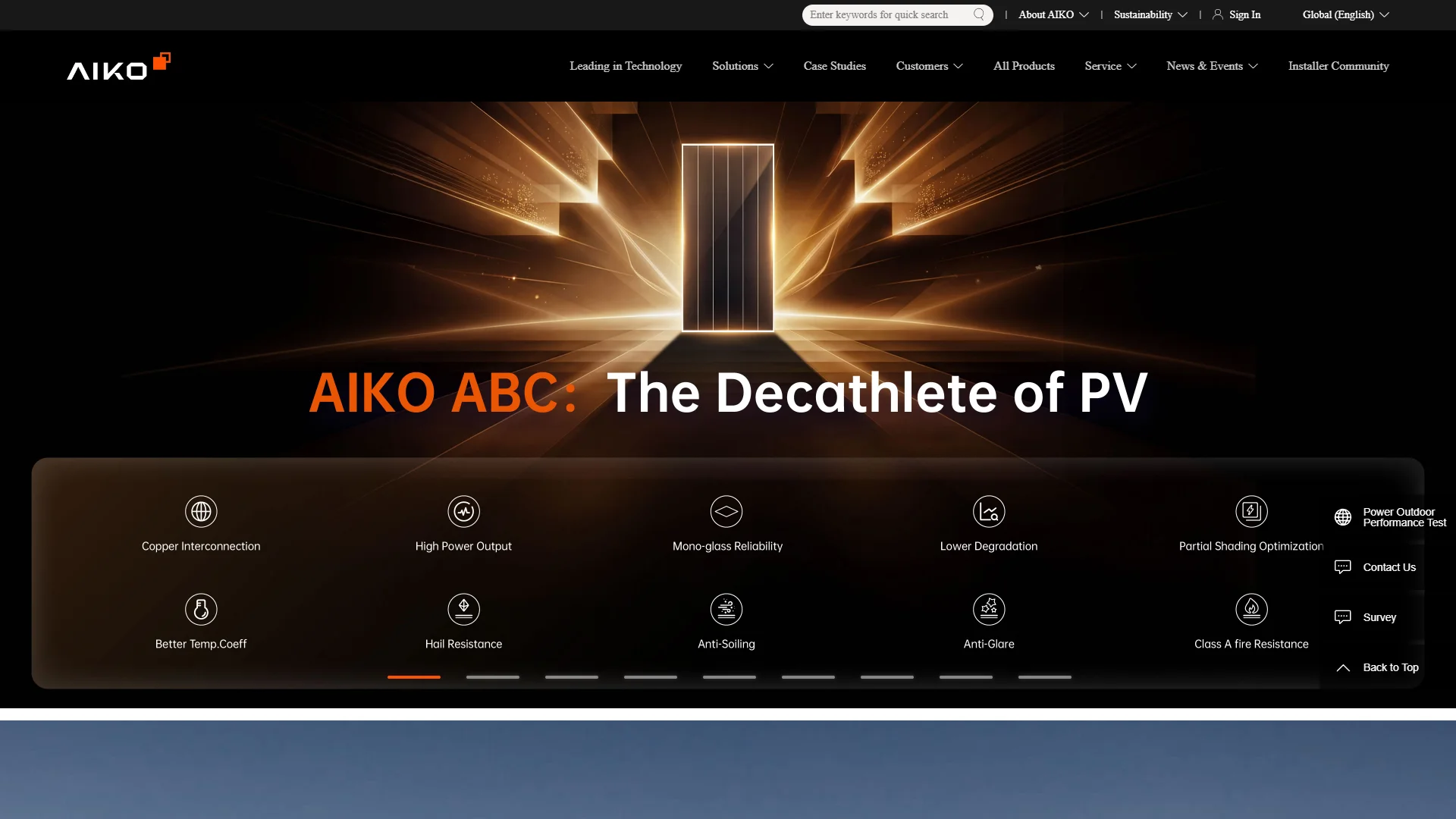
Aikosolar is primarily documented here as a solar-module company rather than a dedicated battery-storage manufacturer. Its ABC module portfolio is described as serving homeowners as well as commercial and industrial customers, with applications extending from rooftops to open-field projects. The supplied research highlights high-power output, safety-oriented design, and stable performance in demanding conditions such as mountainous environments. These modules may form part of a solar-plus-storage installation, but the available evidence does not identify a standalone Aikosolar battery system.
Pros / Key Features
- ABC module platform: Aikosolar’s published product focus is its ABC solar-module technology.
- Residential and C&I relevance: The company describes applications for homeowners and commercial or industrial customers.
- Challenging-site positioning: Its materials refer to demanding conditions including mountains, dust, humidity, salt mist, and other environmental obstacles.
- Storage pairing potential: Solar modules can be paired with a compatible battery system selected from another supplier.
Use Cases / Best For
Aikosolar is best for buyers selecting the solar-generation side of a solar-plus-storage project, especially residential, commercial, industrial, and utility installations. It is not the strongest standalone choice for someone seeking a packaged battery energy storage system based on the information available. Buyers should evaluate module power, efficiency, degradation, temperature coefficients, mechanical loading, certifications, and compatibility with the selected inverter and battery architecture.
How to Choose an Energy Storage System
1. Define the operating objective
Storage for backup power has different requirements from storage for peak shaving, renewable-energy shifting, frequency support, or energy arbitrage. Establish whether the system must operate during outages, reduce demand charges, absorb solar overproduction, or support grid services.
2. Compare usable energy and power
Nominal battery capacity does not always equal usable capacity. Compare usable kilowatt-hours, continuous kilowatt output, peak output, round-trip efficiency, depth-of-discharge limits, and expected degradation. A system with more energy may still be unsuitable if its inverter cannot supply the required load.
3. Check chemistry and safety design
Battery chemistry affects energy density, thermal behavior, cycle life, and operating requirements. LiFePO4 is commonly used in stationary storage, but chemistry alone is not a complete safety assessment. Review cell monitoring, battery-management controls, thermal management, fire detection or suppression provisions, enclosure protection, and applicable certifications.
4. Confirm system compatibility
Verify compatibility between the battery, inverter, energy-management system, solar array, communications interface, and site electrical equipment. This is particularly important for modular batteries, where the installer may need to configure communications and protection settings.
5. Evaluate the installation environment
Temperature range, humidity, salt exposure, dust, altitude, indoor or outdoor placement, noise, ventilation, and seismic or mechanical requirements can affect performance and compliance. Request the complete installation manual and environmental specifications before selecting a model.
6. Review warranty and support
Compare warranty duration, throughput or cycle limits, retained-capacity guarantees, exclusions, response procedures, replacement policy, remote monitoring, software support, and local service availability. A technically strong battery may be unsuitable if support is unavailable in the project region.
7. Calculate total project cost
Purchase price should be assessed alongside inverters, controls, switchgear, installation, commissioning, permits, network studies, transportation, maintenance, insurance, and eventual recycling or disposal. Levelized cost per usable kilowatt-hour can provide a more useful comparison than the battery’s initial price alone.
Final Verdict
Jinkosolar ranks first because it has a clearly documented energy-storage portfolio alongside its established solar technology business, making it the most direct match for utility and commercial storage comparisons. Hero Future Energies is more relevant to renewable-energy development and BESS project partnerships than to off-the-shelf battery procurement. Seplos is a stronger fit for LiFePO4 battery and smart-BMS sourcing, particularly where an integrator will design the wider system. Aikosolar is best viewed as a solar-module supplier for projects that may add a compatible third-party battery. The appropriate choice ultimately depends on the project’s operating purpose, electrical design, site conditions, service requirements, and verified product documentation.
FAQs
Which brand is best for a complete energy storage project?
Among these four, Jinkosolar is the strongest candidate for a complete project-oriented evaluation because it publicly presents dedicated energy storage product families. Buyers should still confirm the exact system configuration, integration scope, warranty, certifications, and regional support for the intended project.
Are solar modules the same as energy storage systems?
No. Solar modules generate electricity, while batteries store electricity for later use. A solar-plus-storage installation normally requires modules, an inverter or power-conversion system, batteries, controls, protection equipment, and suitable installation and monitoring infrastructure.
What information should be requested before buying?
Request the technical datasheet, usable capacity, power ratings, efficiency, chemistry, operating temperature, protection features, certifications, warranty, cycle or throughput limits, communication protocols, installation requirements, expected service life, and details of local technical support.

